Vík Northern Lights
South Coast and Northern Lights Tour
Vík by daylight, aurora after dark from Reykjavík. The 13 hours split into a south coast day and a roughly 3-hour northern lights section that leaves…
- Cancellation
- Free cancellation 24h
- Operator
- Gray Line Iceland
Vík holds 291 residents, one main road and a black beach you can reach on foot. Walk five minutes past the last street light and the sky over Reynisdrangar goes dark enough to work. This page covers the northern lights in Vík, Iceland: where to stand, which forecast to trust, and what the bookable tours give you after dark.
Updated August 2026
Quick answer
Vík works as an aurora base because the dark starts at the edge of the village. From most guesthouses you reach Víkurfjara beach in five to ten minutes, and the sea stacks give you something to put in the frame. What Vík does not have is an evening aurora departure of its own. Every guided hunt on this coast leaves from Reykjavík, 190 km west, so your two real options are sleeping here and watching on foot, or booking a multi-day trip that overnights in the Vík area. Season runs from late September to early April.
Key takeaways
Chasing the northern lights in Vík, Iceland rewards people who stay the night. The village sits on the south coast under Mýrdalsjökull, hemmed in by cliffs on one side and the Atlantic on the other, and it counts 291 inhabitants. That population is the whole point. There is no urban glow to escape, no ring road of lit suburbs, no drive into the countryside at midnight. You put your coat on, walk to the end of the street and the sky is already dark.
The second reason is the foreground. Aurora photographs from Vík carry the Reynisdrangar sea stacks, the black sand and the surf line, and those three things turn a green smear into a picture worth keeping. Most aurora shots taken from a Reykjavík car park could have been taken anywhere in the northern hemisphere. A shot from Víkurfjara could only have been taken here.
The honest catch: Vík is 190 km and about 2.5 hours from Reykjavík on the Ring Road, and the guided aurora hunts all run out of the capital. That gap between what the village offers and what the tour market sells is what the rest of this page is about.
Search any booking platform for a Vík northern lights tour and you get results. Read the meeting points and every one of them starts somewhere else.
Aurora departures on the south coast leave Reykjavík. Gray Line runs its hunt from the BSÍ terminal at 22:00 in autumn and spring and 21:00 through mid-winter. Operators based in Vík sell ice caves, glacier walks and the Lava Show, and all of them finish in daylight.
The reason is arithmetic. A minibus that collects you in Vík at nine in the evening has nowhere better to take you than the beach at the end of your own street. So the tours that name Vík in an aurora context either pass through by day and hunt from the capital at night, or sleep you here as part of a longer itinerary.
Each card says where the aurora part actually happens, because that is the difference nobody prints. The aurora is a night activity and neither of these fills your daylight hours, so pair one with a daytime trip out of the village: the ice cave, the Lava Show and the glacier walk all finish long before the sky matters. See what runs in Vík by day. Booking, payment and cancellation run through GetYourGuide; prices, ratings and review counts here were read from the listings in August 2026, and both carry free cancellation up to 24 hours before departure.
Vík by daylight, aurora after dark from Reykjavík. The 13 hours split into a south coast day and a roughly 3-hour northern lights section that leaves…
The only listing here that has you standing in the Vík area after dark. Nights two and three are booked in the Vík area, days cover…
The aurora cannot be guaranteed on any tour. Operators cancel for cloud and refund or rebook, which is a feature rather than a flaw.
Read the second column first. It answers the only question that matters here: where you are standing when the sky lights up.
| Tour | After dark you are | Duration | Book | From | Rating | |
|---|---|---|---|---|---|---|
| Gray Line south coast + aurora | On a hunt out of Reykjavík | 13 hours | Details | $169.91 | 4.3 (96) | → |
| Snæland 5-day hunt | Sleeping in the Vík area, 2 nights | 5 days | Details | $1,635.56 | 5.0 (9) | → |
Prices are per person and were read in August 2026. The Gray Line day runs its aurora section separately in the evening, roughly 3 hours of the 13. Neither option covers your daylight hours in Vík, which is what the [daytime trips](#daytime) are for.
Dates and current prices for the south coast day, straight from the booking platform. It is the cheaper of the two aurora options and the only one you can book for a single date, as long as you accept that the hunt itself starts in Reykjavík.
Nobody sells this part, so here it is in full. Three things decide your night: cloud, darkness and geomagnetic activity, in that order of importance.
A strong aurora behind thick cloud is an invisible aurora. Start every check with the cloud map on vedur.is, the Icelandic Met Office site, where green areas mark cloud and white areas mark clear sky. Slide through the hours and look for a white patch anywhere within an hour's drive of Vík, not only over the village itself.
South-coast weather moves fast, which cuts both ways. A solid overcast at 9 p.m. can break by midnight. Set an alarm, look out of the window, go back to bed if it is grey. People who commit to one long vigil at 10 p.m. and give up at 11 miss more displays than people who check four times in pyjamas.
The same page carries the aurora activity number for midnight on a 0 to 9 scale, along with darkness, sunrise and moon times. Those clock times are calculated for Reykjavík, so treat them as approximate for Vík, which sits further east and gets dark a few minutes earlier.
The Kp index runs from 0 to 9 and measures geomagnetic activity. Higher means brighter and further south. Kp 3 already produces a steady band over Iceland on a clear night, Kp 5 counts as a minor storm, and anything above 5 is rare.
The number is a forecast, not a schedule. Displays get photographed in Iceland at Kp 0 to 2, and a Kp 5 evening with a full overcast delivers nothing. Treat the Kp figure as the answer to "how good could tonight be" and the cloud map as the answer to "will I see any of it".
The forecast horizon is short. Three days ahead is the practical limit for cloud and activity together, so the 27-day outlooks circulating online are a curiosity rather than a planning tool. Book your nights in Vík for the darkness, then read the forecast on the day.
A new moon leaves the sky at its darkest, and that is when a faint arc across the north still registers to the naked eye. A full moon washes those faint displays out entirely, though a Kp 5 storm cuts through regardless and moonlight lights the black sand and the sea stacks in a way that many photographers prefer.
If your dates are flexible, aim for the week around new moon. If they are not, the moon is not a reason to stay indoors.
Keep it to three sources and check them in order.
The usual window runs from about 10 p.m. to 2 a.m., when geomagnetic activity peaks in the hours around magnetic midnight. Displays appear outside it. October evenings produce sightings before 9 p.m., and a substorm can fire at 4 a.m.
Give your eyes twenty minutes to adapt and keep your phone screen dimmed or red. A display that looks like a pale grey cloud to a fresh eye reads as green on a camera and then as green to you, once you are properly dark-adapted. Faint aurora looks like smoke that will not drift.
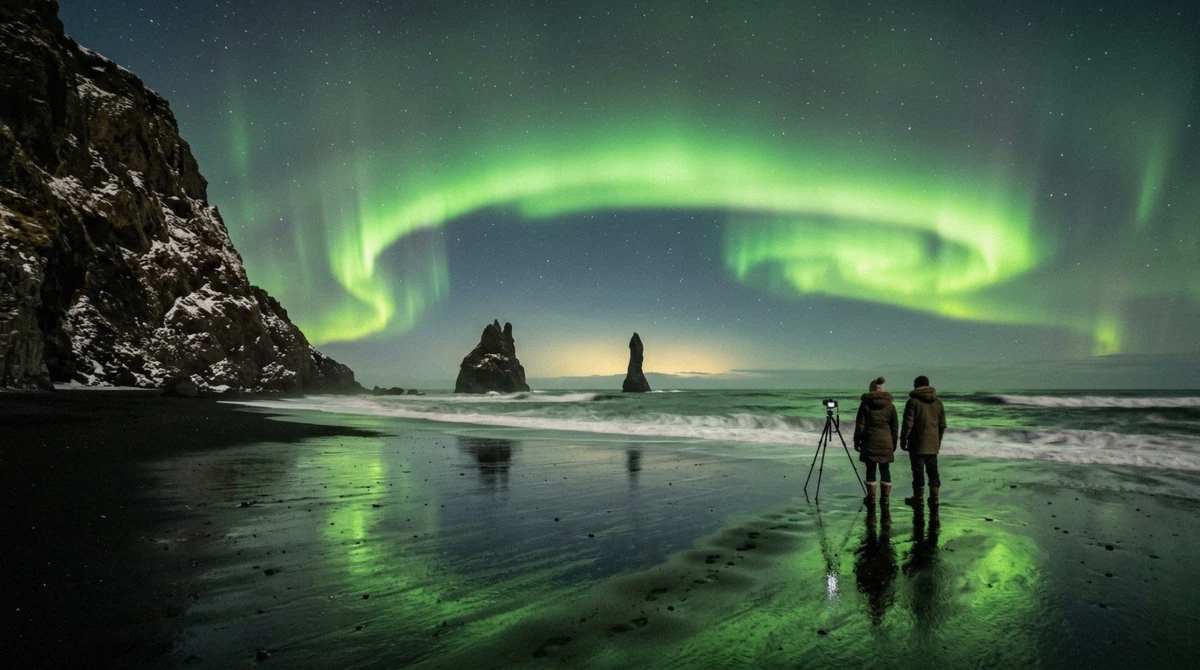
Three spots inside the village work, and one famous beach nearby does not after dark.
The main beach runs south of the village and takes five to ten minutes on foot from most guesthouses. Once you cross the dunes the town disappears behind you and the sky opens from the cliffs in the west to the black sand in the east, with Reynisdrangar standing offshore. There is a gravel car park at the beach if you are driving in from a farm stay outside town.
Stay well back from the water. The Atlantic here produces sneaker waves that run far up the sand without warning, and in the dark you will not see one coming. Set up on the dry sand above the wrack line and keep your back to the village lights.
| Spot | From the village | What you get | Watch out for |
|---|---|---|---|
| Víkurfjara beach | 5 to 10 minutes on foot | Widest sky, sea stacks in frame | Sneaker waves, wind off the sea |
| Víkurkirkja church hill | 10 minutes uphill | Elevated view over the village and the coast | Icy path in winter |
| Behind the N1 | 2 minutes | Quick check without committing | Passing headlights |
| Reynisfjara beach | 10 minutes by car | Basalt columns, famous foreground | Deadly surf, no lighting, avoid at night |
Víkurkirkja, the white church with the red roof, sits on the slope above the village. The walk up takes ten minutes and buys you height, a horizon over the rooftops toward the sea, and shelter from the worst of the wind that scours the beach. On a night when the beach is unbearable, the church hill is still workable.
It is also the spot for a photograph that says Vík rather than Iceland: red roof in the foreground, aurora above, the coast beyond.
The dark ground behind the N1 service station is not scenic and it is the most useful spot in the village. You get there in two minutes, you can see enough sky to judge whether anything is happening, and you go back for your camera or your bed accordingly. Locals use it for the same reason.
Use it as your instrument, then walk to the beach or the hill for the actual watching.
Reynisfjara, the basalt-column beach around the headland, photographs beautifully and kills people. The surf there runs up the sand fast and pulls hard, several visitors have died on it, and at night you cannot read the waves at all. There is no lighting and no fence.
Víkurfjara gives you the same sea stacks from the safe side of the headland. Save Reynisfjara for daylight.
Hours of true darkness per night, month by month, with the average daytime high. The season opens in late September and closes in early April, and the bars show why.
Iceland reaches around 20 hours of darkness at the winter solstice on 21 December. Geomagnetic storms peak around the equinoxes through the Russell-McPherron effect, which is why late September, October, late February and March combine decent darkness with the strongest activity.
The moon does not stop the aurora. It changes which displays reach your eyes, and how the black sand looks in the frame.
A Kp 5 storm punches through full moonlight without trouble. Photographers often prefer a half moon, which lights Reynisdrangar and the surf while leaving the sky dark enough.
In most of Iceland a guided hunt buys you mobility. In Vík you already have the dark, so the calculation changes.
From Reykjavík, a bus with a guide who reads forecasts is worth real money. The capital's glow reaches far, the good spots sit 40 to 90 minutes out, and driving yourself on winter roads at midnight is how holidays end badly. The guide picks the hole in the cloud and someone else handles the ice.
From Vík, that value shrinks. You are standing in the dark spot already. What a multi-day tour still gives you is the driving, the sequencing of the south coast by day, and a professional deciding at 10 p.m. whether tonight is worth the effort.
Nothing beyond a bed. The village has hotels, guesthouses and apartments, several of them a short walk from the beach, and rooms facing the sea let you check the sky without dressing. Book two nights rather than one. Vík's weather is decided by the Atlantic, and a single overcast night is common enough that one-night plans fail often.
Bring layers that survive wind off the water, waterproof outers, warm boots and gloves you can shoot in. Standing still at 2°C in a coastal wind gets cold faster than the number suggests.
The 190 km to the capital take about 2.5 hours in good conditions. In February those conditions include black ice, sheet wind across the Mýrdalssandur, and no lighting. Every guide who knows this coast says the same thing: if you watched the aurora from Vík, sleep in Vík.
If you want the aurora without the winter driving at all, the 5-day guided itinerary removes that decision from your hands.
The village sits on the Ring Road, so getting there is simple. Getting the night right takes a little preparation.
Aurora watching happens after dark, which leaves the short winter daylight free. These three start in or near the village and finish before the sky matters, so the evening on the beach stays open.
Three daylight hours that start and end in Vík, so your evening stays free for the beach. An hour by Super Jeep each way, roughly 30…
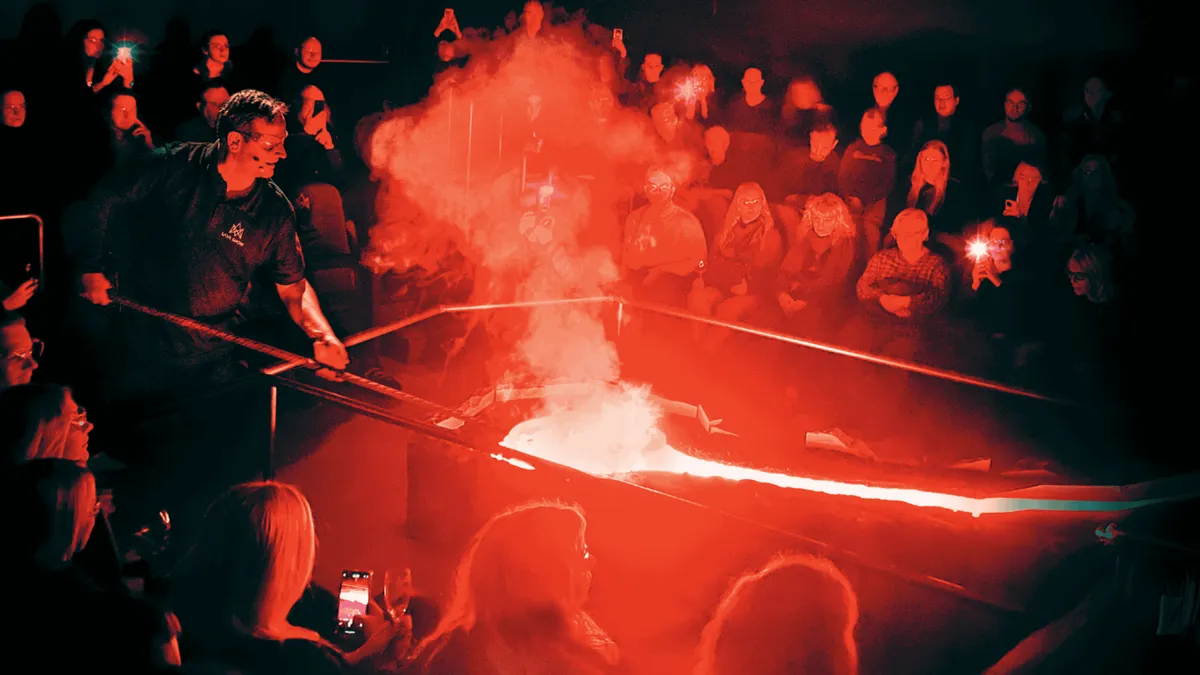 from $53.40Indoors, 50 minutes
 Listing details checked August 2026
Fifty minutes indoors in the middle of the village, which makes it the reliable option when the wind comes off the sea. Real molten lava is poured in…
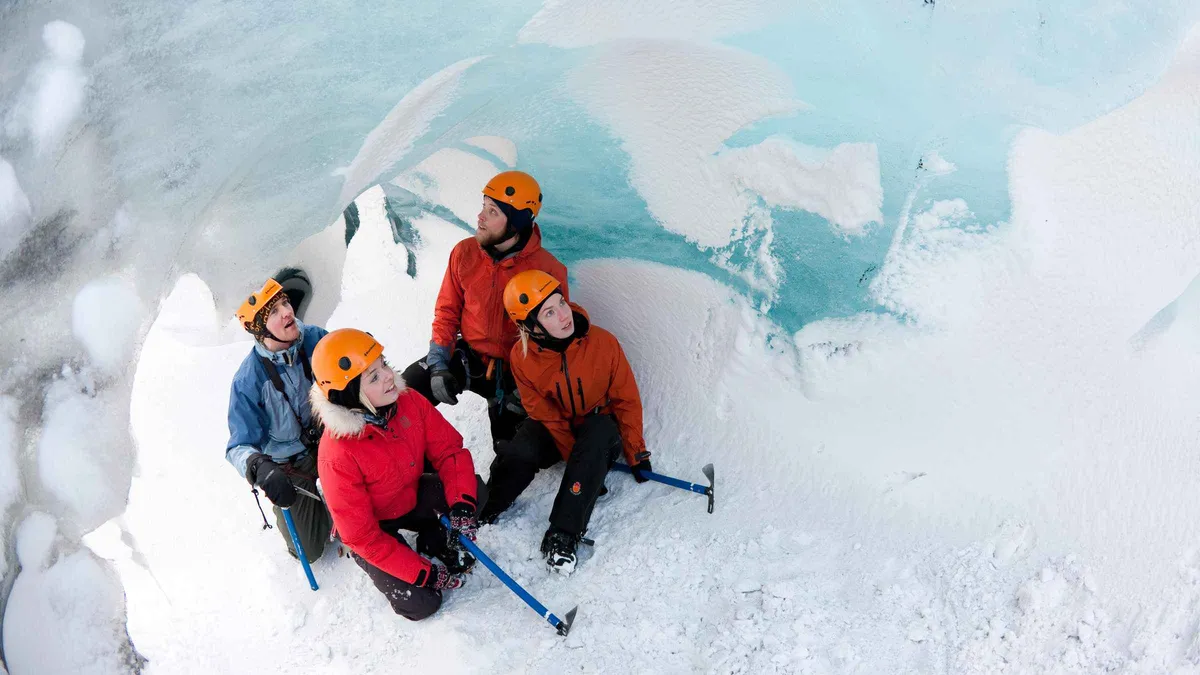 from $106.34Best reviewed
 Listing details checked August 2026
The classic south coast glacier walk, 30 minutes west of Vík and rated 4.7 from more than 1,400 reviews. Certified guides supply crampons, harness, helmet and axe, the…
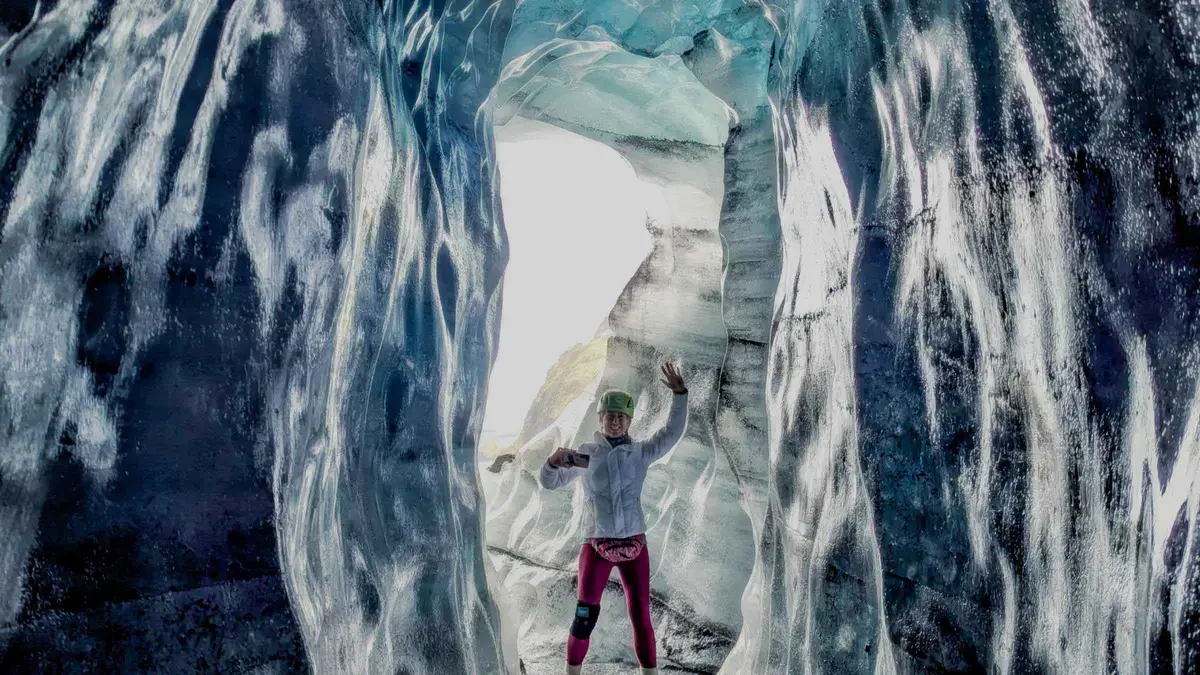
Winter daylight in Vík runs roughly 11:00 to 16:00 in December, so a morning departure leaves the whole evening free for the beach. One caveat on the ice cave: it is not sold to children under 8, to wheelchair users or to travellers with heart problems, and reviewers regularly note how small the cave is and how short the time inside feels.
The only bummer was the weather so we couldn't see the northern lights properly though we did see it on one day near Vik and the weather also spoiled the Reynisfjara beach trip. The driver/guide was very professional and safe/cautious too. Just check the weather for cloudy skies and book this activity accordingly for best results.
Fantastic day trip our guide Eric was amazing his knowledge and professionalism whilst keeping it fun was so refreshing. And our driver Pawel was fantastic in the very very windy conditions thank you. But we just found it was such a busy day we just couldn't face another few hours on the coach in the wind.
Northern Lights canx due to bad weather, but GYG refunded w/in 24hrs. Highly recommend this tour!
Quoted as published on GetYourGuide, including the critical ones. Reviewed August 2026.
Yes, and mainly for a practical reason. Full darkness starts a five-minute walk from the village, so you can check the sky repeatedly through the night without driving anywhere. Add Reynisdrangar and the black sand as foreground and Vík beats most Icelandic bases for effort-to-result. The limits are Atlantic cloud, which arrives often, and the lack of a local evening tour.
No. Guided aurora hunts on the south coast leave Reykjavík, 190 km away. Operators based in Vík sell daytime trips such as the Katla ice cave tour. The nearest thing to a Vík-based aurora tour is the 5-day itinerary that sleeps two nights in the Vík area.
October and March, if you want one answer. Both combine long dark nights with the equinox effect that raises geomagnetic activity, and both avoid the deepest winter weather that keeps the sky shut. December and January give you up to 20 hours of darkness around the solstice, and also the highest chance of a week of cloud.
It is one of the better ones in a decade. Solar Cycle 25 peaked in 2024 and 2025 and activity stays elevated through 2026 and into 2027, which means more frequent and stronger displays. That raises the odds on any given clear night. It does not change the fact that cloud decides your evening.
During a strong display, yes, straight from a hotel window or the street. For a normal display the street lighting is enough to wash out the fainter arcs, which is why the beach, the church hill and the ground behind the N1 are worth the short walk. A phone in night mode picks up what your eye misses; see the photography settings guide.
Open the aurora page on vedur.is from the Icelandic Met Office. It shows a cloud cover map, where white marks clear sky and green marks cloud, plus an activity figure on a 0 to 9 scale for midnight. Check the cloud first. Then use the Hello Aurora app for live sightings reported nearby.
No. Watching from Víkurfjara or the church hill costs nothing and you decide when to go out. A tour is worth paying for when it solves a different problem: winter driving, sequencing the south coast by daylight, or a guide reading the forecast for you. The Gray Line day trip and the 5-day hunt both do that, and our full cost-benefit breakdown runs the numbers.
Two at least. One night gives you a single roll of the dice against Atlantic weather, and cloudy nights outnumber clear ones through much of winter. Two or three nights turn the odds in your favour, and the daytime hours fill themselves with the ice cave, the Lava Show or the glacier. Our guide to where to stay in Vík compares the walkable options.
No operator guarantees a sighting, and any that claims to is selling weather it does not control. Aurora tours are cancelled for cloud and refunded or rebooked. Both aurora listings on this page carry free cancellation up to 24 hours before departure, so a bad forecast does not have to cost you money.
Mid-May to early August. The sky never gets properly dark, so even a strong display goes unseen. Those months are excellent for everything else in Vík, including puffins on the cliffs, and useless for this.
Read next
Detail pages for each listing, plus the practical guides for a night outside in a south coast winter.