 Vík Northern Lights
Vík or Reykjavík for the Northern Lights?
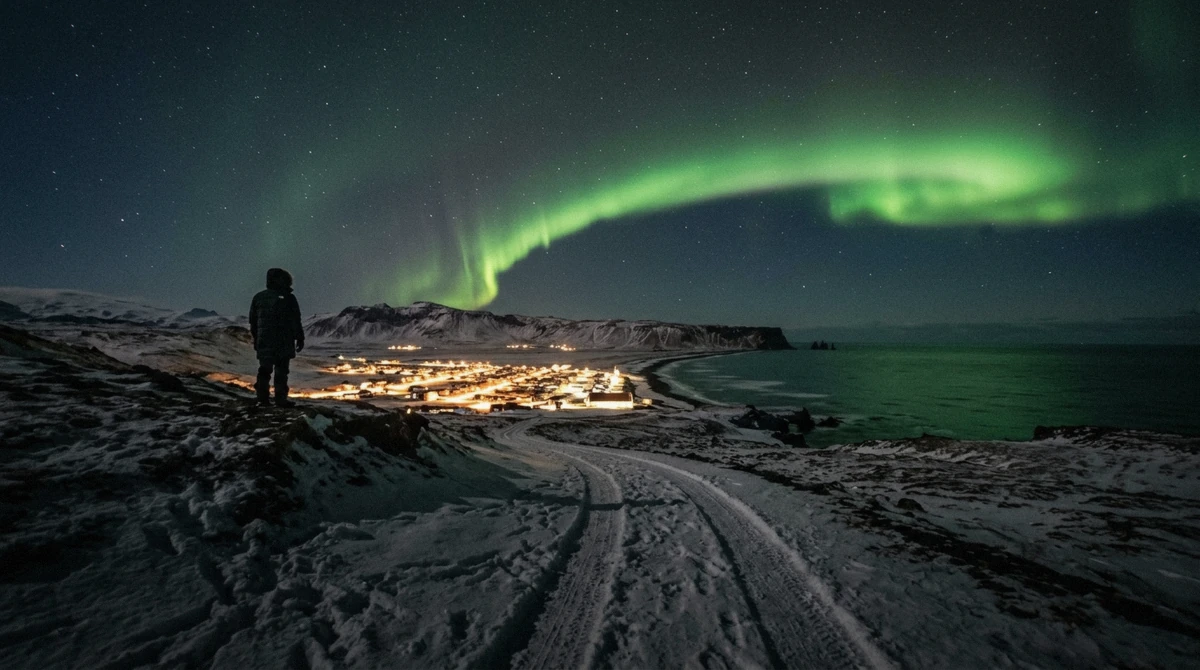
Vík or Reykjavík for northern lights: the question comes down to how much driving you are willing to do after dark. Vík is a village of 291 people, 190 km and about 2.5 hours from Reykjavík on Route 1, with genuinely dark ground a five-minute walk from most beds in town. Reykjavík is Iceland's capital and the country's transport hub, but its own streetlights push the usable dark ground 40 to 90 minutes outside city limits, which is exactly why guided hunts exist there and mostly don't from Vík. Neither base is the objectively correct answer; the right one depends on the rest of the trip already being planned, and the full picture of seeing the northern lights in Vík, Iceland covers what a Vík base actually involves beyond this one comparison.
Quick answer
Vík wins on convenience: full dark starts a five-minute walk from most accommodation, no driving required. Reykjavík wins on choice and infrastructure: more flights, more hotel stock, and organized hunts that handle the 40 to 90 minute drive to dark ground for you. Vík has no evening aurora tour departing from the village itself, so a Vík base means watching on foot rather than being driven to a clear patch.
Key takeaways
- Vík sits 190 km and about 2.5 hours from Reykjavík on Route 1
- No evening aurora tour departs from Vík; a Vík base means checking the sky on foot
- Reykjavík's own good viewing spots sit 40 to 90 minutes outside the city, which is why hunts exist there
- The Gray Line day trip from $169.91 visits Vík by daylight, then hunts from Reykjavík after dark
- The 5-day itinerary from $1,635.56 sleeps two nights in the Vík area, splitting the difference
- Vík is wetter and windier than Reykjavík, so its cloud odds are not automatically the better bet
Tours That Bridge Both Bases
Both of these products exist precisely because Reykjavík and Vík solve the aurora problem differently; each stitches the two together in its own way.
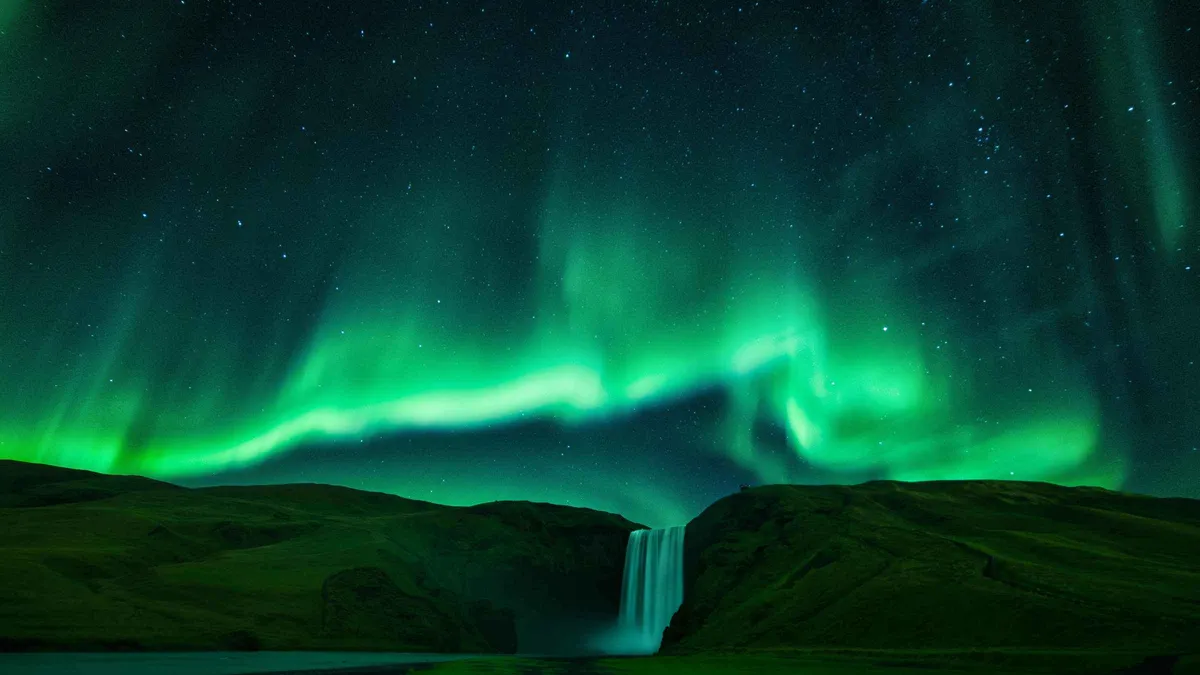
South Coast and Northern Lights Tour
Vík by daylight, aurora after dark from Reykjavík. The 13 hours split into a south coast day and a roughly 3-hour northern lights section that leaves the BSÍ terminal in the evening, so the sky you watch is over the capital region, not the black beach.
- Cancellation
- Free cancellation 24h
- Operator
- Gray Line Iceland
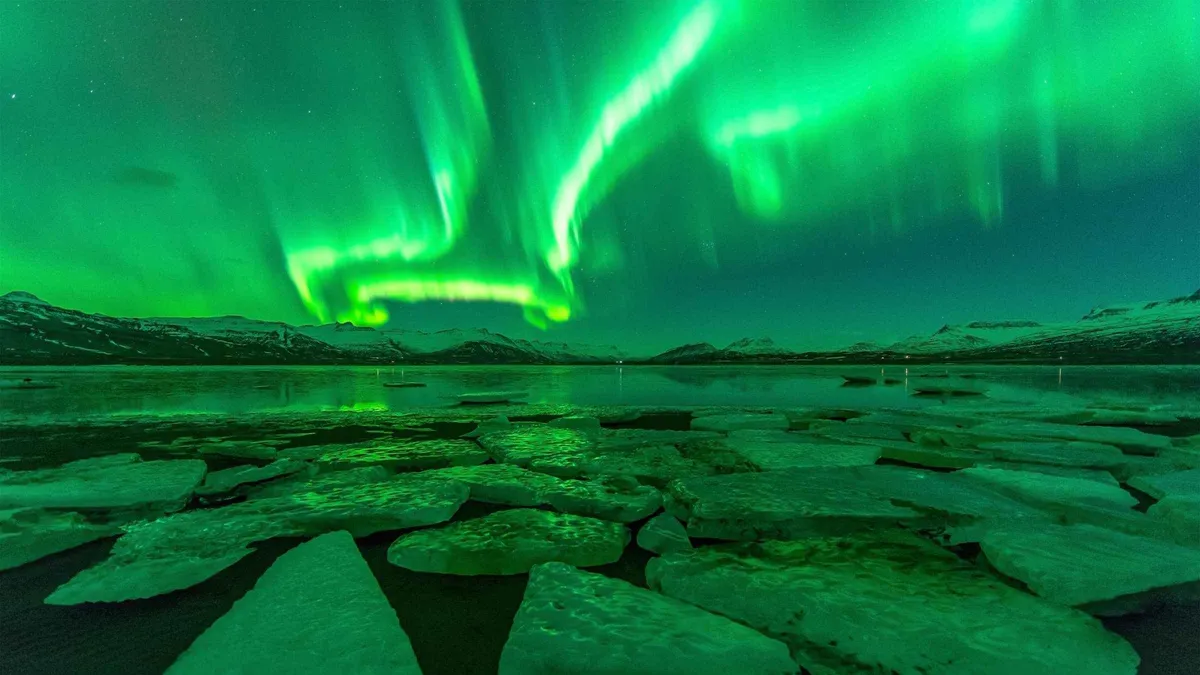
5-Day Northern Lights Hunt & Glacier Lagoon
The only listing here that has you standing in the Vík area after dark. Nights two and three are booked in the Vík area, days cover Þingvellir, Geysir, Gullfoss, Seljalandsfoss, Skógafoss, Reynisfjara and Jökulsárlón, and a guide handles the winter driving.
- Cancellation
- Free cancellation 24h
- Operator
- Snæland Travel
Vík vs Reykjavík
Vík
- 291 residents, no urban glow to escape
- Víkurfjara beach five to ten minutes on foot from most accommodation
- No evening aurora tour departs from the village
- Small room stock, winter dates book out early
- Wetter and windier than Reykjavík, which cuts the other way on clear-sky odds
Reykjavík
- Iceland's capital, largest hotel and flight capacity in the country
- Streetlights push usable dark ground 40 to 90 minutes outside the city
- Multiple organized hunts depart nightly in season, handling the drive for you
- More restaurants, shops and non-aurora activities to fill a cloudy night
- A cancelled hunt still leaves an entire city of alternatives for the evening
Verdict Reykjavík is the better base for a traveler who wants options and infrastructure and is fine being driven to the dark. Vík is the better base for a traveler who wants the sky right outside the door and does not mind a smaller village with fewer backup plans on a cloudy night. Neither verdict changes what actually decides a given night: cloud cover, not the base chosen.
Light Pollution and How Far You Must Drive
Vík's dark starts at the edge of town
Vík's population of 291 means there is barely any streetlight to escape in the first place. Víkurfjara, the black sand beach, sits five to ten minutes on foot from most accommodation, with an open gravel car park and unobstructed sky on a clear night. The church hill at Víkurkirkja adds a ten-minute uphill walk in exchange for a little shelter from the wind.
Reynisfjara, ten minutes away by car, looks tempting on a map but is not a night spot: fast surf, no lighting, and deaths recorded there after dark rule it out regardless of the sky overhead. The ground behind the N1 station covers the fastest option of all, a two-minute check for anyone unsure whether the longer walk is worth it that particular night.
Reykjavík's dark starts on the highway
Reykjavík's own light dome pushes usable dark ground 40 to 90 minutes outside the city, which is the entire reason a driven hunt is worth paying for there in a way it usually isn't from Vík. A traveler without a rental car in Reykjavík has genuinely limited options for reaching dark sky alone at night, which is the market the guided hunts exist to serve. This is also why no evening aurora tour departs from Vík itself: the village already sits in the dark it would otherwise be driving toward.
Why the asymmetry exists
It is tempting to read this as Vík simply being the better base outright, but the comparison is not that clean. Reykjavík's light dome is the price of everything else the capital offers: the international airport, the widest hotel selection in the country, and a guided-hunt industry mature enough to run departures on a fixed schedule through the whole season. Vík's darkness is the flip side of being a village of 291 people with a correspondingly small amount of everything else, including a short list of restaurants and a room stock that sells out fast in winter.
Trading one for the other is the actual decision being made, not a simple upgrade from one town to another.
What Each Base Costs You in a Night
The real spend, side by side
Hotel prices vary too much to pin to a single number, but the aurora-specific cost of each base is concrete and worth comparing directly.
| Base | Aurora-specific cost | What it buys | Getting to dark ground |
|---|---|---|---|
| Vík | Nothing beyond the room | A five to ten minute walk to Víkurfjara or the church hill | On foot, no driving |
| Reykjavík, self-drive | Rental car plus fuel | Access to any dark spot 40 to 90 minutes out, on your own schedule | Self-driven, requires local road knowledge |
| Reykjavík, guided hunt | from $169.91 per seat | A driver who already checked the cloud forecast, plus a full south coast day on this particular tour | Driven, no car needed |
The trade-off underneath the numbers
Vík looks like the free option and largely is one, provided a room there is already booked for other reasons, such as the Katla ice cave or the glacier hike. Reykjavík's free option, a self-driven trip into the dark, only works for a traveler comfortable navigating Icelandic roads at night in winter conditions, which is a real skill requirement the guided hunt exists to remove. Neither base's paid option guarantees a sighting; both are paying for access to dark ground and, in Reykjavík's case, a driver who is watching the forecast professionally.
The rental car middle path
A rental car narrows the gap between the two bases considerably. From Reykjavík, a car turns the 40 to 90 minute drive into a self-timed trip rather than a scheduled tour, at the cost of navigating unlit rural roads in winter conditions. From Vík, a car is optional for the aurora itself but useful for reaching Hotel Katla or Hotel Dyrhólaey, both a short drive outside the village and both sitting in darker surroundings than the village center.
Either way, the car is not what decides whether the sky is clear; it only decides how much control the traveler has over where to be when it is. A traveler weighing a rental car purely for aurora purposes should note that neither base actually requires one to see a display; it only expands the range of spots available on a given night.
The September vs January Split
September and October favor Vík's simplicity
Late September through October sits inside the equinox window that statistically lifts geomagnetic activity, and the season is mild enough that a walk to Víkurfjara after dinner is genuinely pleasant rather than an ordeal. Daylight is still long enough this early in the season that Vík's smaller pool of daytime activities, the Lava Show, the Katla ice cave, the glacier hike, fills a full day comfortably before the evening sky check.
December and January favor Reykjavík's infrastructure
Around the winter solstice on 21 December, Iceland reaches about 20 hours of darkness, which sounds like an advantage everywhere but mostly means long, cold, unstructured evenings in a small village with a short list of open restaurants. Reykjavík's larger hotel and dining base absorbs a long dark evening far better, and its guided hunts run nightly through this exact period, dropping to a 21:00 departure from 1 October through 14 March specifically because the darkness starts earlier. A traveler visiting in deep winter who still wants a night or two in Vík is better served treating it as a short add-on to a Reykjavík-based trip rather than the sole base.
Where the two seasons actually meet
Late February through March closes the loop, carrying the same equinox lift as the autumn window while daylight is already stretching back out. By this point Vík's short winter daylight hours have eased, making a village base easier to fill during the day, and the region's weather, while still wetter and windier than Reykjavík on average, is trending toward the milder pattern that makes an evening walk to the beach more appealing than a midwinter one. A traveler with flexible dates gets the best of both arguments by booking toward either edge of the season rather than its coldest middle.
Month by month, which base earns its keep
Darkness and weather pull in opposite directions across the season, and the base that suits September is not automatically the one that suits January. Read the last column: it is the practical call for that month.
| Month | Dark hours per night | What the weather usually does | Better base |
|---|---|---|---|
| September | About 8 | Mildest of the season, equinox activity high, roads open | Either, and Vík rewards a two-night stay |
| October | About 11 | Longer nights, wind picking up, still easy driving | Vík |
| November | About 15 | Wet and windy on the coast, first ice on the roads | Reykjavík if you are driving yourself |
| December | About 19 | Shortest days, storms common, most cloud | Reykjavík, or Vík with a guide |
| January | About 17 | Cold and clear spells between storms | Vík, if you are not driving at night |
| February | About 14 | Improving, still icy | Vík |
| March | About 11 | Equinox activity, longer daylight for driving | Vík |
Picking a Base
If You have one or two nights total in Iceland
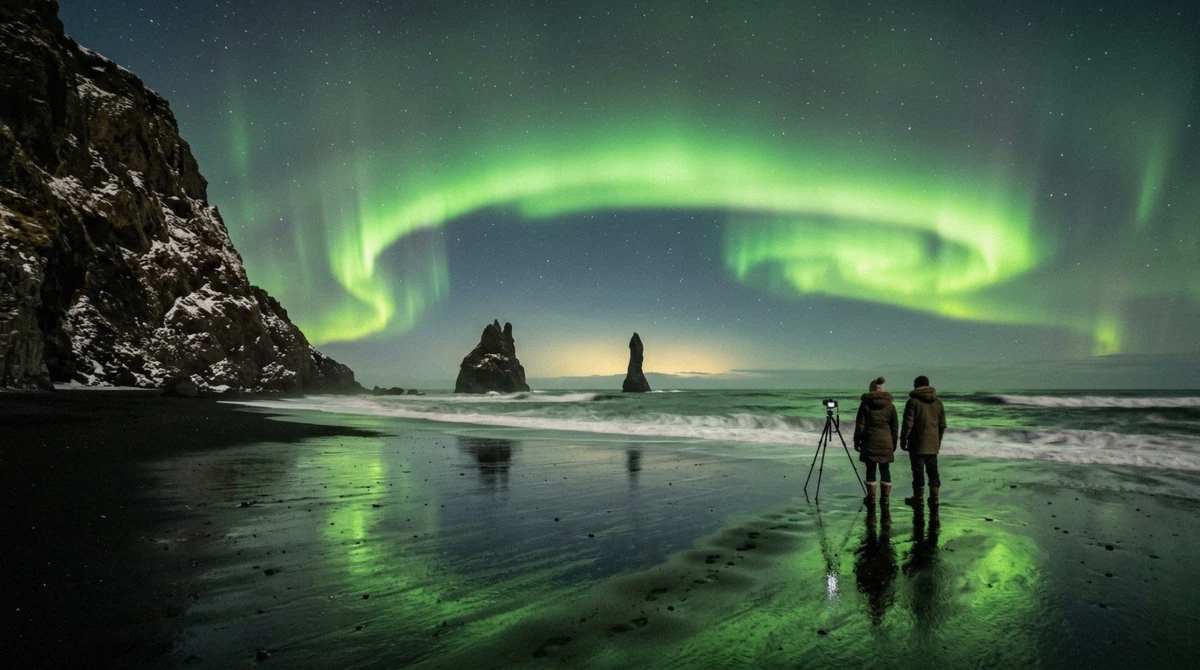
Base in Reykjavík. Its infrastructure and guided hunts absorb a short, uncertain window better than a small village can.
If You have four or more nights and can spend two of them south
Split the trip: Reykjavík for arrival and departure, Vík for the middle nights, as the 5-day itinerary already does.
If You are visiting in December or January
Lean toward Reykjavík as the main base. The long dark evenings are easier to fill there, and driving back from Vík after midnight in winter is the mistake worth avoiding entirely.
If You are visiting in late September or October
Vík works well as a primary base; the season is milder and the equinox window already favors your odds regardless of which town you sleep in.
If You don't want to drive at night in Iceland
Reykjavík, paired with a guided hunt, removes that requirement entirely. Vík removes it too, but only because the dark is already outside your door.
Base Questions
What city in Iceland has the best northern lights?
No single city or town has a documented edge on sightings themselves; the aurora is a nationwide phenomenon governed by the Kp index and cloud cover. What differs by base is how far you must travel to reach dark ground, and on that measure Vík has the shorter walk while Reykjavík has the larger support network.
Is north or south Iceland better for northern lights?
This post covers south Iceland only, comparing Vík against Reykjavík within that region. Both sit on the same forecast and Kp scale as anywhere else in the country; the deciding factor at either latitude is clear sky on the night in question, not which coast you're on.
Can you do a night trip from Reykjavík to Vík to see the northern lights?
Not as a dedicated evening product. The tours that link the two run as full-day or multi-day itineraries, such as the south coast day trip, which visits Vík by daylight and then hunts from Reykjavík after dark, not the other way around.
Is Vík worth visiting even without the northern lights as the goal?
Yes. Reynisdrangar sea stacks, the Katla ice cave, and the glacier hike at nearby Sólheimajökull all stand on their own during daylight hours, with the aurora as a possible evening bonus rather than the only reason to come.
Which base is better in September, and which in January?
September and October favor Vík, when milder weather makes the evening walk comfortable and the equinox window already lifts the odds. December and January favor Reykjavík, where the long solstice darkness is easier to fill and the guided hunts run on a schedule built for that exact stretch of the calendar, dropping to a 21:00 departure from 1 October through 14 March.
How far is Vík from Reykjavík?
190 km, about 2.5 hours by car on Route 1 in good conditions. That distance is why Reykjavík-based hunts and a Vík-based stay solve the same problem in different ways rather than being easily combined into one evening.